

The Millionaire Habits Nobody Talks About: Stay Hungry, Stay Foolish
Stop Being Satisfied: Why Comfort Is the Enemy of Your Bank Balance
Let me ask you something uncomfortable. When was the last time you finished a book that wasn’t assigned to you in school?
When was the last time you learned a skill just because you were curious, not because your boss forced a “mandatory training” on you?
If you’re struggling to remember, don’t worry — you’re not alone. Most of us are living the same loop: wake up, check phone, office, scroll Instagram at lunch, come home, binge a web series, sleep, repeat. Saturday feels like a reward. Sunday feels like mourning for the Monday that’s coming.
And somewhere in this loop, we’ve convinced ourselves this is “settled life.” 9 to 5 Job, EMIs going on time — Alls Well. But is this really your ceiling? Because I promise you, Alls Well has never made anyone a Millionaire. To Become a Millionaire, Lets talk about the Millionaire habits that nobody will tell you – Stay hungry , Stay foolish.
This post is your wake-up call. Not the aggressive, guilt-tripping kind — the kind that hands you an actual plan.
The Cost of Being “Satisfied”
Satisfaction feels safe. It’s comfortable, familiar, and it doesn’t ask anything of you. But here’s the trap: satisfaction with where you are today is basically a contract you’re signing to stay exactly there tomorrow, next year, and probably for the next decade.
Think about the people in your own family or friend circle who are genuinely financially free — the uncle with three properties, the cousin who retired at 45, the neighbour who just bought a Fortuner in cash. Almost none of them got there purely on a salary. They got there because at some point, they refused to be satisfied with “just enough.” They stayed hungry, Stayed Foolish — for knowledge, for skills, for one more income stream.
Meanwhile, the average salaried Indian is fighting inflation with a 6-8% annual increment while prices of literally everything — onions, school fees, rent — grow faster than that. Standing still, in financial terms, is actually moving backward.
Life Doesn’t Ask Permission Before It Throws a Curveball,
Here’s the part nobody wants to think about, but everybody needs to.
You might be sitting there right now thinking, “Sab thik hai yaar — decent salary, EMIs on time, weekend Netflix, occasional weekend dinner out. This is a happy lifestyle.” And it genuinely might be — until the day it isn’t.
Life has a habit of throwing the biggest curveballs, biggest googly, because life is very unpredictable, exactly when things look the smoothest. A sudden health issue — yours or a parent’s, a spouse’s, a child’s. A diagnosis nobody saw coming. A hospitalisation that eats up weeks. Suddenly the job that felt so stable needs you to take unpaid leave, or worse, you’re not in a position to work at all for a while. The salary that was covering everything so comfortably stops arriving, or arrives but can’t stretch far enough, while the bills — medical and otherwise — keep coming.
This isn’t fear-mongering. It’s just how single-income-stream life works: it’s fragile by design, because it depends entirely on you showing up, being fit, and being available, every single month, every single day, without fail. One derailment — health, layoff, family emergency — and the whole structure wobbles.
This is exactly why “happy and comfortable on a 9-to-5” isn’t the same as “financially secure.” A job is an income, not a safety net. The safety net is what you build separately — a passive income stream that keeps earning whether you’re at your desk, in a hospital waiting room, or taking care of someone who needs you.
Passive income isn’t about greed or chasing a millionaire fantasy alone. It’s about building a second engine for your life — one that doesn’t stop just because your primary one needs a break. A blog earning affiliate income while you sleep. A digital product selling on autopilot. Investments compounding quietly in the background. None of these ask you to be “present and performing” every single day the way a job does.
So the next time you tell yourself you’re happy because the job is stable — ask the harder question: what happens to that happiness the day the job, or your health, isn’t stable anymore? If the honest answer makes you uncomfortable, that discomfort is exactly the push you need to start building your passive income today, while things are still going smoothly.
Be Inquisitive Again — You Used to Be or What I call Stay hungry , Stay Foolish.
Remember being a kid and asking “why” about everything? Why is the sky blue, why do we sleep, why does ice float? Somewhere between board exams and job interviews, most of us switched off that switch. We stopped asking “why” and “how,” and started just accepting.
Curiosity is not a personality trait reserved for scientists and toppers. It’s a muscle. And like any muscle, it atrophies when you stop using it — and it grows back the moment you start again.
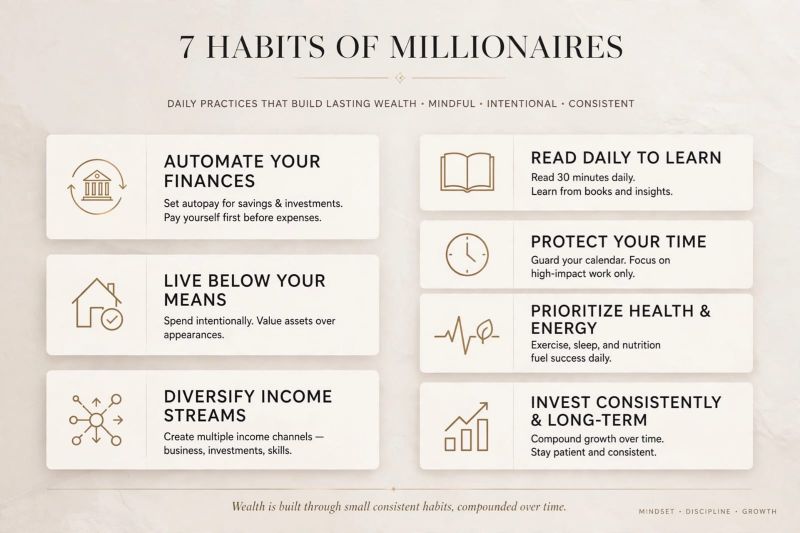
Here’s the simplest Millionaire Habits that will switch your mindset to Become a Millionaire.
Here is a list of simplest Millionaire habits that will switch your mindset and change it to become a millionaire.
1. They Automate Their Finances
Millionaires don’t “try” to save every month. They make saving impossible to skip.
Most of us plan to save whatever’s “left over” at the end of the month. Problem is, in India, with weddings, festivals, and that one cousin who’s always getting engaged, there’s rarely anything left over.
Rich people flip the order: they pay themselves first. The moment salary hits the account, a chunk moves automatically into SIPs, an emergency fund, or a separate savings account — before it has a chance to get spent on Swiggy orders you don’t even remember placing.
Try this: Set up an auto-debit for your SIP for the 2nd of every month, right after salary day. Out of sight, out of temptation.
2. They Read Daily to Learn, Not Just to Scroll
Millionaires treat reading like brushing their teeth — a non-negotiable daily habit. Warren Buffett famously spends most of his day reading. Not reels. Not WhatsApp forwards from group uncles. Actual books, reports, and articles that sharpen how they think about money, business, and life.
This doesn’t mean you need to finish a 400-page book a week. Even 20 focused minutes a day — a personal finance book, a good newsletter, a biography of someone you admire — compounds into serious knowledge over a year.
Try this: Swap one scrolling session a day (you know the one) for 15 minutes of reading something that actually teaches you something.
3. They Live Below Their Means
This one stings a little, especially in a culture where the new iPhone launch feels like a personal invitation. But most self-made millionaires are shockingly unglamorous with their spending. Old cars, modest homes, simple lifestyles — even when they can clearly afford more.
The lifestyle upgrade trap is real: raise ka increment aaya nahi ki naya phone book kar liya. Millionaires break this cycle by keeping their lifestyle several notches below their income, and investing the gap instead.
Try this: Next time your income goes up, resist the lifestyle bump for at least 3-6 months. Let the raise build wealth before it builds a new wardrobe.
4. They Protect Their Time Fiercely
Rich people guard their calendar like it’s Fort Knox — because time, unlike money, can’t be earned back. They say no to meetings that don’t matter, gossip that doesn’t help, and yes, endless scrolling that eats hours without you noticing.
Every hour spent doomscrolling is an hour not spent building a skill, a side hustle, or a relationship that actually adds value to your life.
Try this: Track your screen time for one week. Just look at the number. It’s usually enough to scare you into action.
5. They Prioritise Health and Energy
You can’t compound wealth if you’re constantly running on empty. Millionaires treat sleep, exercise, and stress management as investments, not luxuries — because burnout is expensive. It costs you decision-making ability, focus, and honestly, years off your life.
This is also why you’ll notice a lot of successful people are oddly disciplined about basic things like sleep timing and a morning walk, even while running massive businesses.
Try this: Pick one health habit — 7 hours of sleep, a 20-minute walk, or cutting late-night screen time — and protect it like it’s a client meeting.
6. They Diversify Their Income Streams
Almost no self-made millionaire relies on a single paycheck. Salary pays the bills, but wealth usually gets built through a second (and third) stream — a side business, rental income, dividends, freelancing, or content like this very blog.
The logic is simple: one income stream means one point of failure. Multiple streams mean if one slows down, you’re not sitting there panicking about EMIs.
Try this: Pick one skill you already have and turn it into a small side income this year — even if it starts embarrassingly small.
7. They Invest Consistently and for the Long Term
This is the least exciting habit on this list, and also the most powerful. Millionaires aren’t chasing the next multibagger stock tip from their broker chacha. They invest steadily, month after month, year after year, and let compounding do the heavy lifting.
The real secret isn’t timing the market — it’s time in the market. A boring SIP continued for 20 years quietly outperforms most “hot tips” that came with a WhatsApp forward.
Try this: If you already invest, don’t just continue — increase your SIP amount slightly every year in line with your income.1. Read a Few Pages, Every Single Day
Nobody’s asking you to finish a 400-page book in a week. Read 10 pages a day. That’s it. At that pace, you’ll finish 12-15 books a year — more than most people read in a decade.
500 hours is roughly what it takes to go from “complete beginner” to “good enough to get your first paying client” in most freelance skills. Your phone isn’t the enemy — mindless scrolling is. The same phone that’s draining your time can also be the exact tool that builds your side income, if you flip how you use it.
3.
Redefine What “Working Hard” Means
Now let’s talk about the second part of this — work. And I need to clarify something immediately, because “work 60 hours” can sound like terrible, burnout-inducing advice if misread.
I’m not telling you to grind 60 hours a week at your 9-to-6 job for a boss who’ll forget your name the day you resign. That’s not hard work — that’s just being a well-paid (or underpaid) employee. Real hard work, the kind that changes your family’s financial trajectory, looks different:
Your Job Pays the Bills. It Won’t Make You Rich.
A salary, by design, is priced to keep you comfortable enough to stay, not wealthy enough to leave. That’s not a conspiracy — it’s just how employment economics works. Your CTC is a cost to your company, and companies optimize costs. Nobody’s going to hand you a promotion into millionaire status.
Your Extra Hours Should Build an Asset, Not Just Log Hours
This is the real shift. Working extra hours at your job is “input.” Working extra hours on something you own — a blog, a digital product, a freelance skill, a small business — is “equity.” One trades time for a fixed number. The other can compound.
Some realistic starting points, especially if you’re doing this alongside a full-time job in India:
- Freelancing in whatever your job skill is — sales, design, content, coding, accounting
- Digital products — eBooks, templates, planners, courses on a niche you understand better than most
- A blog or YouTube channel in a space you’re genuinely interested in, monetized over time through ads, affiliate income, or your own products
- Reselling or a small D2C brand — even a modest one run on Instagram and WhatsApp
- Investing systematically — not as a “side hustle” exactly, but a non-negotiable habit that turns your salary itself into a compounding asset over decades
Consistency Beats Intensity
You don’t need to actually work 60-hour days (that’s not even physically sustainable, and this line was clearly meant to grab your attention, not as literal advice). What you need is 1-2 focused hours daily on something that’s yours. Over a year, that’s 365-700 hours poured into an asset instead of just a paycheck. That’s the real difference between people who stay “comfortable” their whole lives and people who become the first crorepati in their family.
To Become a Millionaire – Maybe the First in Your Family Isn’t About Luck
Every wealthy person you admire — whether it’s a business tycoon or just that one relative everyone talks about at weddings — didn’t get there by being satisfied. They got there by the formula of Stay Hungry, Stay Foolish. Be inquisitive, treating their evenings as an investment instead of an escape, and building something that belonged to them, not just to their employer.
You don’t need a lottery ticket. You don’t need to be from a business family. You need:
- A daily habit of learning — even 10 pages of a book
- Ruthless honesty about how much time you’re losing to your phone and TV
- A side income stream you’re actively building, even if it starts small
- Patience to let that income stream compound over months and years, not days
Your Next Step
Pick one thing from this post — just one — and start today. Maybe it’s picking up that book you bought six months ago and never opened. Maybe it’s blocking one hour tonight to research a skill you could freelance in. Maybe it’s finally writing that first blog post or listing that first digital product.
Small, consistent, inquisitive effort — compounded over years — is genuinely how ordinary people become the extraordinary success story in their family. Not overnight. Not without effort. But absolutely, realistically possible.
FAQs
Q1. How can I start a side income while working a full-time job in India? Start with a skill you already use at work — sales, writing, design, spreadsheets — and freelance it in your free hours. One to two focused hours a day is enough to begin building a client base or a small digital product.
Q2. Is reading really that important for financial success? Reading exposes you to frameworks and mistakes other people have already made, so you don’t have to learn everything the expensive way. Even 10 pages a day compounds into 12-15 books a year, which is more than most people read in a decade.
Q3. How much time should I realistically dedicate to a side hustle daily? One to two consistent hours a day is far more sustainable and effective than sporadic bursts of “hustle.” Over a year, that adds up to 365-700 hours invested in something you own.
Q4. What’s the easiest side income to start with no investment? Freelancing your existing job skill or starting a niche blog are the lowest-cost entry points — both need time and consistency far more than they need capital.
If you like the content :
Read Related Articles:
7 AI Tools for your Online Business that make Side Hustles easy to start and Grow.
How to make money as a College Student: The 4 Pillars of Success.

Truly eye-opening blog sir!
Point about building passive income while things are smooth really hit home.
And “Job pays bills, it won’t make you rich” – 100% true.
Started reading Atomic Habits because of your recommendation.
Thank you!
Very insightful blog sir
“Read a Few Pages Every Single Day” and “Don’t Just Scroll” are the best takeaways.
I have started reading 10 pages daily.
The point about building passive income while things are smooth really motivated me.
Thank you for sharing your wisdom!