
Exclusive Book Summary: Rich Dad Poor Dad
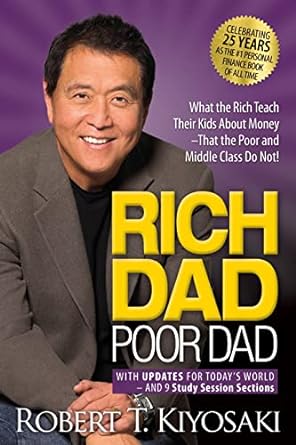
“Rich Dad Poor Dad” is a bestselling personal finance and self-help book written by Robert T. Kiyosaki. The book was first published in 1997 and has since become a classic in the field of financial education. It presents a unique perspective on money, wealth, and financial independence through the lens of Kiyosaki’s own life experiences and the lessons he learned from his two “dads.”
The book is structured as a series of lessons, anecdotes, and practical advice, all of which revolve around the starkly contrasting philosophies of Kiyosaki’s two father figures:
- Rich Dad: This character represents Kiyosaki’s best friend’s father, who was a successful entrepreneur and investor. Rich Dad is portrayed as a financially astute individual who believed in the power of financial education, entrepreneurship, and investing. He emphasizes the importance of financial literacy, the value of assets over liabilities, and the idea of making money work for you.
-
Poor Dad: Kiyosaki’s biological father, who was well-educated and held a stable job, represents this character. Poor Dad adheres to the traditional path of education, job security, and saving money. He advocates getting a good education and working for a steady paycheck, even if it means sacrificing one’s dreams and financial independence.Throughout the book, Kiyosaki shares anecdotes and conversations that he had with the rich dad, who guided him on various aspects of money, wealth creation, and financial independence. He learns valuable lessons about the difference between assets and liabilities, the power of financial education, and the importance of taking calculated risks. Kiyosaki emphasizes the significance of acquiring assets that generate income, such as real estate and businesses, as opposed to liabilities that drain money, such as excessive consumer debt and unnecessary expenses. He introduces concepts like the cash flow quadrant, which categorizes individuals as employees, self-employed, business owners, or investors, highlighting the advantages and disadvantages of each quadrant.
-
The book also delves into the mindset and beliefs around money, discussing the importance of developing a positive relationship with wealth and overcoming limiting beliefs. Kiyosaki stresses the need for financial literacy and encourages readers to take control of their financial destinies by seeking out opportunities, learning from mistakes, and continuously educating themselves about money.
This Book Is Divided into Three Parts
Part One: The first part of this book focuses on the core differences between people in the four quadrants. It showswhy certain people gravitate to certain quadrants and often get stuck there without realizing it. It will help you identify where you are today in the quadrant and where you want tobe in five years.
Part Two The second part of this book is about personal change. It’s more about who you have to be, instead of what you have to do.
Part Three The third part of this book explains how to find success on the right side of the CASHFLOW Quadrant. I will share more of my rich dad’s secrets on the skills required to be a successful B and I. It will help you choose your own path to financial freedom.
Throughout Rich Dad’s CASHFLOW Quadrant, I continue to stress the importance of financial intelligence. If you want to operate on the right side, the B- and I-quadrant side, you must be smarter than if you choose to stay on the left side, the E- and S-quadrant side. To be a B or I, you must be able to control the direction of your cash flow. This book is written for people who are ready to make changes in their lives to move beyond job security and begin to build their own pipelines to achieve financial freedom. We are in the Information Age which offers more opportunities for financial reward than ever before. Individuals with the skills of the B’s and I’s will be able to identify and seize those opportunities. To be successful in the Information Age, a person needs information from all four quadrants. Unfortunately, our schools are still in the Industrial Age and still prepare students for only the left side of the CASHFLOW Quadrant.
-
Key concepts and lessons from “Rich Dad Poor Dad” include:
- Assets vs. Liabilities: Kiyosaki introduces the concept that true wealth is built by acquiring income-generating assets and minimizing liabilities. Assets put money in your pocket, while liabilities take money out.
- Financial Education: The book emphasizes the importance of financial education and self-improvement. Kiyosaki suggests that formal education often lacks practical lessons on money management, which is crucial for financial success.
- Entrepreneurship: Rich Dad encourages the idea of entrepreneurship and creating your own sources of income. This can include starting a business or investing in income-producing ventures.
- Taking Risks: Kiyosaki suggests that calculated risks are necessary to achieve financial success. Fear of failure often holds people back from pursuing opportunities that could lead to wealth.
- Mindset: The book underscores the significance of developing a wealthy mindset. This involves changing one’s perception of money and understanding that it’s not just about working for money but making money work for you.
- Financial Independence: “Rich Dad Poor Dad” promotes the goal of achieving financial independence, where your passive income exceeds your expenses, providing you with the freedom to choose how you live your life.
Overall, “Rich Dad Poor Dad” challenges conventional financial wisdom and encourages readers to think differently about money and wealth. It’s not just a book about how to get rich but a guide to financial literacy and the mindset necessary for achieving financial freedom and success. The book has inspired many to take control of their financial futures and make informed choices about money.